


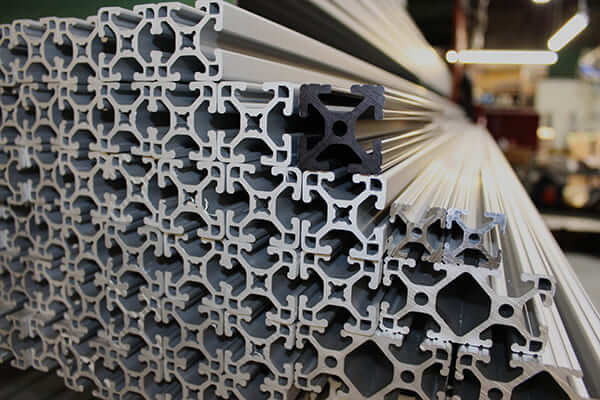


80 20 aluminum extrusion (80/20 aluminum extrusion or 8020 aluminum extrusion) has revolutionized the way engineers, Mga Taga-disenyo, and hobbyists approach structural framing and custom construction.
Known for its distinctive T-slot design, this modular aluminum framing system offers unparalleled flexibility, ease of assembly, and a robust ecosystem of compatible components.
Mga Nilalaman
Ipakita
1. Pagpapakilala
The concept of modularity has transformed numerous industries, and structural framing is no exception. 80/20 aluminum extrusion stands at the forefront of this evolution.
Kahulugan ng 80 20 Aluminum Extrusion
80 20 aluminum extrusion refers to a specific type of extruded aluminum profile, most notably characterized by its T-shaped slots running along its lengths.
The name “80/20” comes from 80/20 Inc., a pioneer in T-slot aluminum profiles and accessories. Today, many use the term more broadly to refer to similar T-slot framing systems.
These extrusions act like an industrial “erector set,” allowing for the creation of an almost limitless variety of structures without welding or specialized tools.
With 8020 aluminum extrusion be used to build structures that are 80% complete in 20% of the time compared to traditional methods, hence the name “80/20.”
Significance of 80 20 in Modular Construction and Design
The significance of 80/20 aluminum extrusion lies in its ability to empower rapid prototyping, custom automation solutions, and reconfigurable designs.
It eliminates the need for traditional fabrication methods like welding and drilling for connections, drastically reducing assembly time and labor costs.
This modularity makes it ideal for projects requiring frequent modifications, custom one-off builds, or scalable production lines.
2. Overview of the 80/20 Aluminyo haluang metal
Alloy Designation and Industry Standards (hal., 6000-Serye, ASTM B221)
80/20 aluminum extrusion profiles are predominantly manufactured from 6000-series aluminum alloys.
The most common alloys you will encounter for these T-slot profiles are 6105-T5, 6063-T5/T6, and sometimes 6061-T6.
These alloys all offer a good balance of strength, extrudability, paglaban sa kaagnasan, and surface finish quality, making them well-suited for modular framing systems.
- 6105 Haluang metal: Often chosen for T-slot applications due to its slightly higher minimum mechanical properties compared to 6063 in the T5 temper. It provides good structural integrity.
- 6063 Haluang metal: Known for its excellent surface finish and superior extrudability, making it ideal for profiles where aesthetics are a key consideration or more intricate shapes are required. It’s still robust enough for many framing needs.
- 6061 Haluang metal: A very versatile and widely used structural 6061 aluminum extrusion. In the T6 temper, it offers higher strength than both 6105-T5 and 6063-T5/T6. While it can be slightly more challenging to extrude into very complex T-slot profiles compared to 6063, its higher strength makes it a good option for more demanding 80/20 aluminum extrusion Mga aplikasyon.
Chemical Composition Range
The chemical composition of the 6000-series alloys used for 80/20 aluminum extrusion is carefully controlled to achieve the desired properties.
Magnesiyo (Mg) and Silicon (Si) are the primary alloying elements.
| Elemento | Nilalaman (%) (Approximate) |
|---|---|
| Silikon (Si) | 0.6 – 1.0 |
| Bakal (Fe) | ≤ 0.35 |
| Tanso (Cu) | ≤ 0.10 |
| Mangganeso (Mn) | ≤ 0.10 |
| Magnesiyo (Mg) | 0.45 – 0.8 |
| Chromium (Cr) | ≤ 0.10 |
| Sink (Zn) | ≤ 0.10 |
| Titanium (Ti) | ≤ 0.10 |
| Iba pa, bawat | ≤ 0.05 |
| Iba pa, kabuuang | ≤ 0.15 |
| Aluminyo (Al) | Balanse |
Mga Pangunahing Pisikal na Katangian
The physical properties contribute significantly to the versatility of 8020 aluminum extrusion.
- Densidad ng katawan: Humigit-kumulang 2.70 g/cm³ (0.0975 lb/in³).
- Saklaw ng Pagtunaw: Humigit-kumulang 600 – 655 ° C (1112 – 1211 ° F) para sa 6105/6063 Mga haluang metal.
- Thermal kondaktibiti: Humigit-kumulang 200 W / m · K (for T5 temper).
- Kondaktibiti ng Elektrikal: Humigit-kumulang 45-50% IACS (for T5 temper).
- Modulus ng Elasticity (Young’s Modulus): Humigit-kumulang 69 GPa (10,000 ksi).
- koepisyent ng thermal expansion: Humigit-kumulang 23.4 μm / m · ° C (20-100 ° C).
3. Mga Katangian ng Mekanikal & Heat Treatment of 8020 Aluminum Extrusion
The strength and stiffness of 8020 aluminum extrusion frames depend on the alloy’s mechanical properties, achieved through specific heat treatment.
Standard Tempers (T-slots are typically T5 or T6)
80/20 aluminum extrusion profiles are most commonly supplied in the T5 o T6 pag-uugali.
- T5 Temper: Cooled from an elevated temperature shaping process (extrusion) and then artificially aged. This is a common temper for 6105 at 6063 alloys used in T-slot profiles, offering a good balance of strength and cost-effectiveness.
- T6 Temper: Solution heat-treated and then artificially aged. This temper provides higher strength than T5 and is used where maximum structural performance is required.
Lakas ng Paghatak, Lakas ng Ani, Elongation Data
The mechanical properties define the load-bearing capacity of 80/20 aluminum extrusion.
| Pag-aari | Minimum Value (ASTM B221) | Karaniwang Halaga |
|---|---|---|
| Ultimate Tensile Strength (MPa) | 260 | 270 – 290 |
| Tensile Yield Strength (MPa) | 240 | 250 – 270 |
| Elongation in 50mm (%) | 8 – 10 | 10 – 14 |
| Lakas ng Gupitin (MPa) | – | ~170 |
| Ang katigasan ng ulo (Brinell, HBW) | – | ~80-90 |
How Aging and Quenching Affect Frame Stiffness
The heat treatment process, including quenching (rapid cooling after extrusion or solution heat treatment) and aging (precipitation hardening), is crucial for developing the final mechanical properties.
- Quenching: A rapid quench from the extrusion temperature (for T5) or solution heat treatment temperature (for T6) “freezes” the alloying elements (Mg and Si) in a supersaturated solid solution.
- Aging: Subsequent artificial aging at a controlled temperature (hal., 175-200°C for several hours) causes fine precipitates of magnesium silicide (Mg₂Si) to form throughout the aluminum matrix. These precipitates act as obstacles to dislocation movement, significantly increasing the strength and hardness (and thus stiffness) ng 80/20 aluminum extrusion. Proper control of these steps ensures consistent and optimal performance.
4. Unique Features of 80/20 Extrusion Profiles
Ang katangian ng katangian ng 80/20 aluminum extrusion is its T-slot geometry.
Modular T-Slot Geometry Explained
The “T-slot” is a recessed channel running along the length of the extrusion.
This slot takes the shape of an inverted ‘T,’ enabling specialized T-slot nuts or fasteners to slide into the channel and lock into place at any position.
This enables connections to be made anywhere along the profile’s length without drilling or welding, forming the basis of its modularity.
Slot Dimensions, Slot Nuts & Fastener Compatibility
80 20 aluminum extrusion profiles come in various series (hal., 10 Serye, 15 Serye, 25mm series, 40mm series) which dictate the overall profile dimensions and, crucially, the T-slot dimensions.
- Slot Width: Standardized for each series (hal., 10 series typically has a ~0.255″ or 6mm slot opening).
- T-Slot Nuts: These are specially designed nuts (hal., drop-in T-nuts, slide-in T-nuts, economy T-nuts) that fit into the T-slot. Once a bolt is tightened into the T-nut, it anchors against the internal shoulders of the slot, creating a strong connection.
- Fasteners: Standard bolts (hal., socket head cap screws, button head cap screws) are used with T-slot nuts. The thread size (hal., 1/4-20, M6, M8) depends on the profile series and T-nut.
Accessory Ecosystem (Brackets, Joiners, Panels)
A vast ecosystem of compatible accessories is a hallmark of 80/20 aluminum extrusion systems:
- Brackets: Angle brackets, gussets, and pivot joints for creating strong, rigid connections at various angles.
- Joining Plates: Flat plates used to connect profiles end-to-end or side-by-side.
- End Fasteners & Anchor Fasteners: Allow for hidden or strong end connections.
- Panel Mounts & Mga Gasket: For incorporating panels (plastik, wood, metal) into the frame.
- Feet, Casters & Levelers.
- Handles, Hinges & Latches.
This extensive range of accessories makes it easy to build highly functional and customized structures.
5. 80/20 Extrusion Manufacturing Process
The creation of high-quality 80 20 aluminum extrusion profiles involves a precise manufacturing process.
Billet Preparation & Pre-Heating
- High-quality 6xxx series aluminum alloy billets are cut to appropriate lengths.
- The billets are pre-heated in an induction furnace or oven to a specific extrusion temperature (hal., 450-500° C), making the aluminum malleable.
Die Design for T-Slot Profiles
The design of the extrusion die is critical for achieving the precise T-slot geometry and overall profile dimensions of 80/20 aluminum extrusion.
- Dies are made from hardened tool steel.
- For hollow T-slot profiles—especially in larger series—manufacturers use complex multi-part dies like bridge, porthole, or spider dies. These dies split the metal and then guide it to rejoin within the die chamber, forming the internal cavities and T-slots.
Press Types and Typical Pressures
Hydraulic extrusion presses force the heated billet through the die.
- Direct Extrusion: The most common method.
- Pressures: Can range from hundreds to thousands of tons, depending on the profile size, complexity, and alloy.
Email Address *, Straightening & Stretching Steps
- Email Address *: As the 8020 aluminum extrusion emerges from the die, it is carefully cooled using air or water quenches. The cooling rate is critical for achieving the desired metallurgical properties for the T5 or T6 temper.
- Stretching: After cooling, the extrusions are typically stretched by 1-3%. This process straightens the profile, relieves internal stresses, and can slightly improve mechanical properties.
- Email Address *: Workers or automated systems straighten the profiles and then cut them to standard or custom lengths.
Kontrol sa Kalidad (Dimensional Tolerances, Straightness)
Rigorous quality control ensures that 80/20 aluminum extrusion meets specifications:
- Dimensional Checks: Using calipers, micrometers, and profile projectors to verify cross-sectional dimensions, T-slot accuracy, and wall thicknesses.
- Straightness & Twist: Checked against industry standards.
- Pagtatapos ng Ibabaw: Inspected for die lines, mga gasgas na, or other imperfections.
- Mechanical Property Testing: Periodically performed on samples after aging to verify strength and ductility.
6. Mga Paggamot sa Ibabaw & Finishes for 80/20 Aluminum Extrusion
Suppliers offer 80/20 aluminum extrusion in various surface finishes, and it supports additional fabrication processes.
Mga Paggamot sa Ibabaw
- Tapusin ang Mill: The natural, slightly matte finish as it comes from the extrusion process.
- Clear Anodizing: The most common finish for 80/20 aluminum extrusion. It provides a durable, lumalaban sa kaagnasan, and aesthetically pleasing silver-matte surface. Anodizing also increases surface hardness.
- Black Anodizing: Offers a sleek, black appearance with the same protective benefits as clear anodizing. Popular for aesthetics in displays or certain machinery.
- Patong ng pulbos: Can be applied for specific color requirements or enhanced chemical resistance, though less common than anodizing for standard T-slot profiles.
Machining and Fabrication
While the main advantage of 80/20 aluminum extrusion lies in its bolt-together, weld-free assembly, users can also machine it to meet specific custom requirements.
- Cutting to Length: Precision cutting is standard.
- Drilling & Tapping Holes: For mounting accessories, sensors, or custom components.
- Milling: For creating custom cutouts, pockets, or angled surfaces.
- Counterboring: For flush mounting of fastener heads.
Many suppliers offer machining services, or users can perform these operations with standard metalworking tools.
7. Mga aplikasyon ng 80/20 Aluminum Extrusion
The modularity and ease of use of 80/20 aluminum extrusion make it suitable for an incredibly diverse range of applications.
Automation Frames & Machinery Guarding
- Building robust frames for automated machinery and robotic cells.
- Creating safety guarding and enclosures around equipment, easily integrating clear panels or wire mesh.
Test Fixtures, Workstations & Ergonomic Carts
- Constructing custom test fixtures for R&D and quality control.
- Designing ergonomic workstations, assembly tables, and flow racks.
- Building mobile carts and material handling solutions.
Custom Shelving, Display Racks & Architectural Elements
- Creating heavy-duty custom shelving units for industrial or commercial use.
- Building trade show booths, retail displays, and museum exhibits.
- Incorporating into architectural elements like room dividers or decorative frames.

Robotics, Conveyor Systems & Prototyping Labs
- Building frames for mobile robots and AGVs (Automated Guided Vehicles).
- Constructing modular conveyor systems.
- Widely used in university labs, makerspaces, and R&D departments for rapid prototyping and experimental setups.
- DIY projects ranging from simulator rigs to custom furniture.
8. Mga kalamangan & Limitations of 80/20 Extrusion
Advantage of 8020 Aluminum Extrusion
Rapid Assembly & Reconfiguration
- Fast, easy assembly using simple hand tools. No welding or specialized labor required.
- Highly reconfigurable. Structures can be easily modified, expanded, or disassembled and reused.
Paglaban sa kaagnasan & Magan na Lakas
- Excellent natural corrosion resistance, further enhanced by anodizing.
- High strength-to-weight ratio, making structures easy to handle and reducing overall load.
Cost Comparison vs. Welded Steel Frames
- While the material cost per unit length might be higher than steel, 80/20 aluminum extrusion often results in lower overall project costs due to significantly reduced labor for design, fabrication, and assembly. No painting is typically required.
Limitations of 8020 Aluminum Extrusion
Limitations in High-Temperature or High-Vibration Environments
- Aluminum alloys lose strength at elevated temperatures (typically above 150-200°C).
- High-vibration environments can cause bolted connections in T-slot systems to loosen over time, so using locking fasteners or thread-locking compounds is essential to maintain stability. Welded structures are generally better for extreme vibration.
- Stiffness can be lower than an equivalent steel frame, which might be a factor in very high-precision applications or long, unsupported spans.

9. Comparison with Other Framing Systems
| System | Assembly Speed | Timbang | Reusability | Typical Cost |
|---|---|---|---|---|
| 8020 Extrusion | Mataas (Mga oras) | Mababa | Napakahusay | Katamtaman |
| Sheet‑Metal Welded Frame | Mababa (days) | Mataas | Mababa | Mababa |
| Aluminum Angle & Channel | Katamtaman | Katamtaman | Makatarungan | Mababa |
| Composite Modular Framing | Mataas | Mababa | Mabuti | Mataas |
- 80/20 Aluminum Extrusion: Faster design-to-build, reconfigurable, no finishing required, cleaner assembly.
- Welded Steel: Potentially higher stiffness and strength for a given size, better for extreme vibration, often lower material cost but higher labor/fabrication cost.
- Angle/Channel: Requires drilling and bolting or welding for all connections, less adaptable.
- Composite Systems: Can offer non-conductive or corrosion-proof benefits in specific chemical environments, sometimes lighter.
10. Pagpapanatili & Recycling of 80/20 Aluminum Extrusion
Recyclability of 6000-Series Aluminum
Aluminyo, including the 6000-series alloys used for 80/20 aluminum extrusion, ay lubos na recyclable.
It can be recycled repeatedly without significant loss of quality, requiring only about 5% Enerhiya na kinakailangan upang makabuo ng pangunahing aluminyo.
Lifecycle Energy Savings
The lightweight nature of aluminum contributes to energy savings in transportation if the final product is mobile.
The ease of disassembly also promotes reuse over disposal.
End‑of‑Life Disassembly & Reuse
80/20 aluminum extrusion frames can be easily disassembled at the end of their service life.
Components can often be reused for new projects, or the aluminum can be efficiently recycled.
11. Langhe Advantages of Supplying 80 20 Aluminum Extrusion
Langhe offers precision‑machined 8020 extrusions in custom lengths, backed by ISO 9001 certification.
Our in‑house anodizing and fabrication capabilities shorten lead times to 5–7 business days.
Technical support guides you from CAD model to finished frame.
- Extensive inventory of various 80/20 compatible profile series and sizes.
- Precision cutting and machining services for customized solutions.
- Competitive pricing and fast lead times.
- Knowledgeable technical support and design assistance.
- Commitment to quality control and adherence to industry standards.
- Wide range of compatible fasteners, brackets, and accessories.
- Experience in supplying diverse industries with 80/20 aluminum extrusion solutions.
12. Konklusyon
80 20 aluminum extrusion and similar T-slot framing systems have fundamentally changed the landscape of custom structural design and automation.
Their unparalleled modularity, ease of assembly, robust strength, and extensive accessory ecosystem provide a powerful toolkit for innovation across countless industries.
From simple DIY projects to complex industrial machinery, 80/20 aluminum extrusion offers a fast, Kakayahang umangkop, and cost-effective solution.
By understanding its properties, manufacturing process, and application strengths, users can effectively harness this versatile technology to bring their designs to life efficiently and effectively.
Mga Kaugnay na Produkto
-

 Mga profile ng aluminyo
2020 Aluminum Extrusion Profiles – Modular T‑Slot Framing System
¥3,550.00Build custom workstations, machine guards, and robot frames with versatile 2020 aluminum extrusion. Our precision‑machined T‑slot profiles offer easy assembly, endless reconfiguration, and strong, lightweight support.
-

 Mga profile ng aluminyo
Unlock Ultra-Precision with 7075 T6511 Extrusion
¥6,550.00With its stress-relieved t6511 temper, 7075 t6511 extrusion ensures superior dimensional stability and exceptional machinability for components demanding the tightest tolerances.
-

 Mga profile ng aluminyo
6061 Aluminum Extrusion
¥3,900.00Explore 6061 aluminum extrusion, the versatile alloy for strong, lightweight profiles. Learn about its T6 temper, Mga katangian, processing, and wide-ranging industrial uses.