


1070 aluminum foil occupies a distinct and critical niche defined by one primary characteristic: exceptional purity.
As a member of the commercially pure (1xxx series) aluminum grades, 1070 aluminum boasts a minimum aluminum content of 99.7%, setting it apart from many common alloys and bestowing upon it a unique set of properties highly valued in specific electrical, thermal, and chemical applications.
Understanding the intricacies of 1070 aluminum foil is essential for engineers, designers, manufacturers, and anyone involved in applications where high electrical or thermal conductivity, excellent formability in the annealed state, and superior corrosion resistance are paramount.
Its properties differ significantly from higher-strength alloys or even other “pure” aluminum grades like 1100 or 1050, dictating its suitability for specific uses such as electrical capacitors, transformer windings, heat exchanger fins, and specialized packaging or sealing components.
This definitive guide provides a deep dive into 1070 aluminum foil.
We will meticulously explore its composition and what defines it within the aluminum alloy system.
Furthermore, we will analyze its critical properties – electrical, thermal, mechanical, and chemical – explaining how its high purity influences each characteristic.
We will also examine the crucial role of temper, particularly the annealed (O) state, compare 1070 foil to its close relatives, detail its manufacturing journey, showcase its key applications, outline relevant industry standards, and offer concluding insights.
Our aim is to deliver an authoritative, comprehensive resource that leaves the reader with a profound understanding of 1070 aluminum foil and its significant role in modern technology and industry.
Contents
show
1. Defining the Material: What is 1070 Aluminum Foil?
Before delving into the foil format, understanding the base alloy, 1070 aluminum, is fundamental.
1.1 The 1xxx Aluminum Series Context
Aluminum alloys utilize a four-digit designation system established by The Aluminum Association.
The 1xxx series designates aluminum compositions with a minimum purity of 99.00% aluminum.
These are often referred to as “commercially pure” aluminum grades.
The last two digits in the 1xxx series designation indicate the minimum aluminum percentage above 99.00%.
For example, 1100 aluminum has a minimum purity of 99.00% Al, while 1050 has a minimum purity of 99.50% Al.
1.2 Specifics of 1070 Aluminum
Following the designation system, 1070 aluminum signifies an aluminum alloy with a minimum purity of 99.70% aluminum.
The remaining 0.30% consists of controlled trace amounts of impurities, primarily iron (Fe) and silicon (Si).
Controlling these impurities is crucial, as even small variations can affect properties like electrical conductivity.
1.3 Key Characteristics Derived from Purity
This high purity is the defining feature of 1070 aluminum and directly translates to several key characteristics:
- Excellent Electrical Conductivity: Fewer impurity atoms mean less scattering of electrons, leading to superior electrical conductivity compared to less pure aluminum alloys.
- Excellent Thermal Conductivity: Similarly, high purity facilitates efficient heat transfer.
- Superior Corrosion Resistance: The inherent resistance of aluminum to corrosion via its protective oxide layer is maximized in high-purity grades.
- Excellent Workability/Formability: Pure aluminum is very soft and ductile, making 1070 highly formable, especially when annealed.
- Lower Mechanical Strength: Compared to alloyed aluminum (like the 3xxx, 5xxx, or 6xxx series), 1070 has relatively low mechanical strength.
1.4 Non-Heat-Treatable Nature
Like all 1xxx series alloys, 1070 aluminum is non-heat-treatable.
Its strength cannot be increased through precipitation hardening heat treatments (like solution heat treating and aging) used for alloys in the 2xxx, 6xxx, and 7xxx series.
Consequently, the strength and hardness of 1070 products are controlled solely through strain hardening (cold working, such as rolling) and annealing (softening heat treatment).
This makes temper designations particularly important for defining the material’s final properties.
2. Understanding 1070 Aluminum Foil
Now, let’s focus on the specific format: 1070 aluminum foil.
2.1 Defining “Foil” by Thickness
In the aluminum industry, the term “foil” generally refers to rolled aluminum products having a thickness of less than 0.2 mm (0.0079 inches).
Material thicker than this is typically classified as sheet or plate.
This definition, widely adopted by organizations like The Aluminum Association, distinguishes foil by its extreme thinness.
Some specifications might use slightly different thresholds, but the sub-0.2mm mark is a common standard.
2.2 How 1070 Aluminum Foil is Made
Producing foil involves taking a thicker slab or sheet of 1070 aluminum and subjecting it to extensive cold rolling.
This process involves multiple passes through powerful rolling mills at or near room temperature.
Each pass reduces the thickness and, importantly, imparts strain hardening (work hardening) into the material, increasing its strength and hardness while decreasing its ductility.
To achieve the very thin gauges required for foil and control the final properties (temper), intermediate annealing steps might be necessary.
2.3 The Significance of the Foil Format for 1070
Presenting the high-purity 1070 alloy in foil format leverages its inherent properties in unique ways:
- Maximizes Surface Area: Creates a large surface area relative to volume, beneficial for heat transfer and certain chemical/electrical processes.
- Flexibility and Conformability: Allows the material to be easily bent, wrapped, and shaped.
- Barrier Properties: Provides an excellent barrier against light, moisture, gases, and microorganisms (when sufficiently thick and properly sealed).
- Combines Purity Benefits with Form Factor: Enables the high electrical/thermal conductivity and corrosion resistance of 1070 to be utilized in thin, flexible applications.
3. Key Properties of 1070 Aluminum Foil
The high purity of the 1070 alloy dictates the primary characteristics of 1070 aluminum foil, making it uniquely suited for specific applications.
3.1 Exceptional Electrical Conductivity
This is arguably the most critical property driving the use of 1070 aluminum foil.
Pure aluminum is an excellent electrical conductor, second only to copper among common non-precious metals when compared by volume, but significantly lighter.
- Purity Effect: The 99.7% minimum purity of 1070 means there are very few impurity atoms or alloying elements within the aluminum crystal lattice to impede the flow of electrons. This results in significantly higher electrical conductivity compared to less pure aluminum like 1100 or alloyed grades like 3003 or 5052.
- Conductivity Rating: Electrical conductivity is often expressed relative to the International Annealed Copper Standard (IACS). Pure aluminum has a conductivity of about 61-62% IACS in the annealed state. 1070 aluminum foil, especially in the soft O temper, closely approaches this theoretical maximum for commercially pure aluminum, typically exceeding 61% IACS.
- Applications: This high conductivity makes 1070 aluminum foil ideal for:
- Electrical Capacitor Foil: Used as the electrode plates in electrolytic capacitors, where high conductivity minimizes energy loss (Equivalent Series Resistance – ESR).
- Transformer Windings: Used as foil windings in power distribution transformers, particularly dry-type transformers, offering weight savings and efficient current carrying compared to copper (when designed appropriately for the larger cross-section needed).
- Electrical Shielding: Its conductivity helps in shielding against electromagnetic interference (EMI) in certain applications.
3.2 Excellent Thermal Conductivity
Parallel to its electrical conductivity, the high purity of 1070 aluminum foil also results in excellent thermal conductivity.
- Mechanism: Heat transfer in metals is facilitated by both lattice vibrations (phonons) and the movement of free electrons. The high number and mobility of electrons in pure aluminum contribute significantly to its ability to conduct heat efficiently. Fewer impurities mean less scattering of these energy carriers.
- Performance: 1070 aluminum exhibits thermal conductivity values near the top end for aluminum alloys, typically around 220-230 W/(m·K) at room temperature in the O temper. This is superior to highly alloyed aluminum grades.
- Applications: This property makes 1070 aluminum foil highly suitable for:
- Heat Exchanger Fins: Used extensively as fin stock in various types of heat exchangers (radiators, evaporators, condensers) where efficient transfer of heat between a fluid and the surrounding air is crucial. Its formability allows easy shaping into complex fin geometries.
- Heat Sinks: Used in applications requiring efficient dissipation of heat away from components, often where formability into specific shapes is also needed.
- Thermal Insulation Facing: Used as a reflective facing material on insulation bats or boards, reflecting radiant heat due to its surface properties and conducting heat effectively across its surface.
- Cookware/Bakeware (Specific Types): Can be used in applications demanding rapid and even heat distribution.
3.3 Superior Corrosion Resistance
Pure aluminum naturally forms a thin, tough, transparent, and self-healing layer of aluminum oxide (Al₂O₃) upon exposure to air.
This passive oxide layer provides excellent protection against many common corrosive environments.
- Purity Advantage: In high-purity aluminum like 1070, the oxide layer forms very effectively and uniformly, maximizing this natural protection. There are fewer alloying elements or impurities that might disrupt the layer or create localized galvanic cells.
- Performance: 1070 aluminum foil exhibits excellent resistance to:
- Atmospheric corrosion (weathering).
- Corrosion by various types of water (including high-purity water).
- Attack by many organic acids and foodstuffs.
- Many neutral or mildly acidic/alkaline chemical solutions.
- Limitations: Like all aluminum alloys, 1070 is susceptible to attack by strong acids (like hydrochloric acid) and strong alkalis (like sodium hydroxide). It can also be prone to galvanic corrosion if placed in direct contact with more noble metals (like copper or stainless steel) in the presence of an electrolyte.
- Applications: Its excellent corrosion resistance is vital in:
- Chemical Equipment Liners/Seals: For handling compatible substances.
- Food Packaging: Providing a safe, inert barrier (often laminated or coated).
- Architectural Applications: Reflective insulation facing, certain decorative elements.
3.4 Low Mechanical Strength but High Ductility (Especially O Temper)
As a high-purity, non-heat-treatable aluminum, 1070 inherently possesses low mechanical strength compared to structural aluminum alloys.
- Tensile and Yield Strength: In the fully annealed (O temper) condition, 1070 exhibits very low tensile and yield strength values. This means it cannot bear significant structural loads.
- Ductility and Formability: The counterpart to low strength is extremely high ductility and excellent formability, particularly in the O temper. 1070 aluminum foil in the annealed state is very soft and malleable. It can undergo severe bending, deep drawing, stamping, and complex forming operations without cracking or fracturing.
- Strain Hardening Effect: Cold rolling significantly increases the strength and hardness (moving towards H1x or H2x tempers) but drastically reduces ductility and formability. Therefore, for applications requiring extensive shaping, the O temper is almost always specified.
- Applications Benefiting from Formability:
- Deep-drawn capacitor cans.
- Intricately folded heat exchanger fins.
- Flexible gaskets and seals.
- Conformable packaging applications.
3.5 Excellent Weldability and Brazability
1070 aluminum foil is readily joined using various methods, though the thinness of foil requires specific techniques.
- Welding: Easily weldable using TIG (GTAW) and MIG (GMAW) processes, although these are less common for foil gauges. Laser beam welding and resistance welding are often more suitable for joining thin foils. Using a matching filler metal (like 1100) is recommended to maintain purity and corrosion resistance. The heat of welding will anneal the material in the HAZ.
- Brazing: 1070 foil exhibits excellent brazability, crucial for manufacturing heat exchangers where fins are often brazed to tubes. Careful control of brazing temperatures and fluxes is necessary.
- Soldering: Can be soldered using appropriate fluxes and solder alloys designed for aluminum.
3.6 Other Important Properties
- Physical Properties:
- Density: Low density (approx. 2.71 g/cm³), contributing to lightweight applications.
- Appearance: Can range from matte (if double-rolled) to bright, depending on the final rolling pass and surface treatment.
- Non-Magnetic: Important for certain electrical and electronic applications.
- Non-Toxic: Safe for food contact applications (must comply with relevant regulations).
- Reflectivity: High reflectivity to both light and radiant heat, contributing to its use in insulation and decorative applications.
- Workability: Besides forming, it is generally easy to cut, slit, and process due to its softness (in the O temper).
4. Understanding Temper Designations for 1070 Aluminum Foil
Temper designation is critical for defining the final properties of 1070 aluminum foil.
Since it’s non-heat-treatable, tempers relate to strain hardening and annealing.
4.1 O Temper: Annealed (Fully Soft)
- Description: This temper signifies that the foil has been fully annealed after the final cold rolling process. Annealing involves heating the foil to a specific temperature to allow full recrystallization of the grain structure, eliminating the effects of strain hardening.
- Properties: Results in the softest, most ductile, and most formable condition for 1070 foil. It also typically yields the highest electrical and thermal conductivity as internal stresses and crystal defects are minimized.
- Dominant Use: The O temper is the most common and important temper specified for 1070 aluminum foil because most applications leverage its high purity benefits in combination with maximum formability (e.g., capacitors, deep-drawn parts, intricate fins) or conductivity (which is highest in the soft state).
4.2 H Tempers: Strain-Hardened
While less common for typical high-purity applications emphasizing softness, H tempers indicate strain hardening:
- H1x Tempers (Strain-Hardened Only): The ‘x’ indicates the degree of strain hardening (e.g., H12 – quarter hard, H14 – half hard, H18 – full hard, H19 – extra hard). Increasing the ‘x’ value means higher strength and hardness but significantly lower ductility and formability. H18 or H19 might be used for specific flat applications requiring slightly more rigidity than O temper, like certain types of fin stock or nameplates, but forming capabilities become very limited.
- H2x Tempers (Strain-Hardened and Partially Annealed): Similar strength levels to H1x tempers but often with slightly better ductility. Less commonly specified for 1070 foil than O or potentially H1x.
Temper Selection Summary:
For most applications leveraging the unique benefits of 1070 aluminum foil (high conductivity, high purity, excellent formability), the O temper is the standard choice.
H tempers might be considered only if a slight increase in rigidity is required for a relatively flat application and the loss of formability is acceptable.
5. Comparative Overview: 1070 Aluminum Foil vs. Related Aluminum Foils
Positioning 1070 foil relative to its close cousins in the 1xxx series and other common foils helps clarify its specific advantages.
| Feature | 1070 Foil (O Temper) | 1060 Foil (O Temper) | 1050 Foil (O Temper) | 1100 Foil (O Temper) | 3003 Foil (O Temper) |
|---|---|---|---|---|---|
| Min. Purity (Al) | 99.70% | 99.60% | 99.50% | 99.00% | ~98.6% (Alloyed w/ Mn) |
| Elect. Cond. | Highest | Very High | Very High | High | Moderate |
| Thermal Cond. | Highest | Very High | Very High | High | Moderate |
| Corrosion Res. | Excellent | Excellent | Excellent | Excellent | Good |
| Strength | Lowest | Very Low | Very Low | Low | Moderate |
| Formability | Excellent | Excellent | Excellent | Excellent | Very Good |
| Cost (Approx.) | Higher | Moderate | Moderate | Lower | Low |
| Primary Niche | Max Purity/Cond. | High Purity/Cond. | High Purity/Cond. | General Pure Al Uses | General Purpose Foil |
Key Comparisons:
1070 vs. 1060/1050:
1070 offers the highest purity and thus marginally better electrical/thermal conductivity and potentially corrosion resistance compared to 1060 and 1050.
The differences are small but can be critical in demanding electrical applications like high-performance capacitors or specific chemical processes.
1070 is typically slightly more expensive due to the tighter impurity control required.
Strength and formability are very similar among these three in the O temper.
The choice often depends on the specific conductivity requirements and cost/availability trade-offs.
1070 vs. 1100:
1100 aluminum (99.00% Al min.) is a very common “commercially pure” grade.
1070 offers significantly better electrical and thermal conductivity due to its higher purity.
1100 might have slightly higher strength due to the higher level of impurities acting as minor alloying agents, but both are very soft in the O temper with excellent formability.
Choose 1070 when conductivity is paramount; choose 1100 for general pure aluminum applications where cost is more critical and peak conductivity isn’t needed.
1070 vs. 3003:
3003 is the workhorse alloy foil, strengthened by manganese.
It offers considerably higher strength than 1070 but has significantly lower electrical and thermal conductivity and slightly lower general corrosion resistance.
Choose 1070 for conductivity, purity, and maximum formability; choose 3003 for applications needing more strength and general utility (like standard packaging, basic heat exchangers, cookware).
6. The Journey of Creation: Manufacturing 1070 Aluminum Foil
Bringing 1070 aluminum foil to life involves a carefully controlled manufacturing sequence designed to maintain purity and achieve the desired thickness and temper.
6.1 High-Purity Melting and Casting
The process begins with melting high-purity primary aluminum ingot.
Great care is taken to avoid contamination during melting and handling.
Alloying additions are minimal and precisely controlled to meet the strict 99.70% minimum aluminum requirement, primarily managing iron and silicon levels.
The purified molten aluminum is then typically cast into large slabs or billets using methods like Direct Chill (DC) casting, which promotes a uniform structure.
6.2 Homogenization and Hot Rolling
The cast slab undergoes homogenization – a high-temperature soaking process – to ensure chemical uniformity and prepare the structure for rolling.
Following this, the slab is hot rolled, passing through large rolling mills at elevated temperatures to significantly reduce its thickness into a coil of intermediate gauge plate or sheet.
6.3 Intensive Cold Rolling
This is where the transformation into foil occurs.
The coil is fed through a series of cold rolling mills.
Multiple passes are required, progressively reducing the thickness.
- Strain Hardening: Each pass imparts cold work, making the aluminum harder and stronger but less ductile.
- Lubrication and Cooling: Special rolling oils lubricate and cool the rolls and the foil strip to manage friction and heat generated during the high-pressure rolling process.
- Intermediate Annealing (if needed): If the foil becomes too hard to reduce further without cracking, it may undergo an intermediate annealing step before further cold rolling.
- Gauge Control: Precision sensors monitor and control the foil thickness throughout the process to meet tight tolerances.
- Double Rolling: For the thinnest gauges, two layers of foil might be rolled simultaneously. The sides in contact with the polished rolls become bright, while the foil-to-foil sides remain matte.
6.4 Final Annealing (Temper O)
For most 1070 aluminum foil applications requiring softness and maximum conductivity/formability, the final critical step is annealing.
The tightly wound coils of cold-rolled foil are heated in large annealing furnaces under a controlled atmosphere (to prevent oxidation) to a specific temperature and held for a period sufficient to achieve full recrystallization and softening (O temper).
Precise control of the annealing cycle (temperature, time, cooling rate) is essential to achieve consistent properties.
6.5 Slitting and Finishing
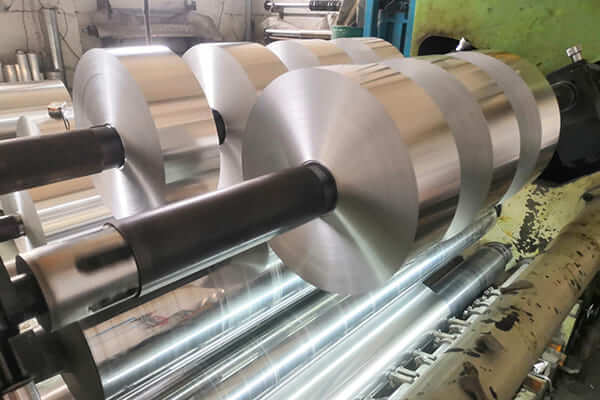
After annealing, the wide master coils are slit into narrower widths according to customer requirements using precision slitting machines.
The edges must be clean and burr-free.
Depending on the application, the foil might undergo additional surface treatments (like cleaning or degreasing) or be wound onto specific core types.
Rigorous quality inspection occurs throughout, checking dimensions, surface quality, and mechanical properties.
7. Key Applications of 1070 aluminum foil
The unique profile of 1070 aluminum foil, dominated by high purity, conductivity, and formability, makes it the material of choice for several specialized applications:
7.1 Electrical Capacitors
This is a primary application. Thin 1070 aluminum foil (often O temper) serves as the electrode material in electrolytic capacitors.
Its high electrical conductivity minimizes energy losses (low ESR), and its high purity is crucial for the electrochemical etching process used to increase the surface area (enhancing capacitance) and for overall capacitor reliability and lifespan.
Its excellent formability allows it to be tightly wound with dielectric materials.
7.2 Transformer Windings
1070 aluminum foil (typically O temper) is used as the conductor in the windings of certain types of electrical transformers, particularly dry-type distribution transformers and power transformers.
Compared to traditional copper wire windings, foil windings can offer:
- Better heat distribution and potentially lower operating temperatures.
- Improved space utilization (higher fill factor).
- Reduced axial short-circuit forces.
- Significant weight savings. The high conductivity of 1070 is essential for efficient current carrying.

7.3 Heat Exchangers (Fin Stock)
While 1100 or 3003 are also used, 1070 aluminum foil (often O temper or a slightly harder H temper like H14 if rigidity is needed) is selected for heat exchanger fins when maximum thermal conductivity is required for optimal heat transfer efficiency.
Its excellent formability allows the creation of complex louvered or wavy fin designs to maximize surface area and air turbulence.
Its good corrosion resistance ensures durability.
7.4 Specialized Packaging
While less common than lower-purity alloys for general food packaging, high-purity 1070 aluminum foil might be used in specific pharmaceutical or electronic packaging applications where chemical inertness, a highly reliable barrier, or specific surface properties related to purity are required.
7.5 Thermal Insulation and Heat Shielding
Its high reflectivity to radiant heat and good thermal conductivity make 1070 foil effective as a reflective layer in high-performance insulation systems or as heat shields, particularly where formability to complex shapes is needed.
7.6 Gaskets and Seals
In the soft O temper, 1070 aluminum foil is highly conformable and can be used to create effective gaskets or seals for specific applications requiring its chemical resistance and temperature tolerance, particularly where a soft, malleable metal seal is desired.
7.7 Chemical Equipment Components
Due to its excellent corrosion resistance to certain chemicals and high-purity water, 1070 foil might be used for lining small vessels, creating diaphragms, or other components in specialized chemical processing or laboratory equipment.
8. Industry Standards and Specifications
Ensuring the quality, consistency, and interchangeability of 1070 aluminum foil relies on adherence to recognized industry standards. Key standards include:
- ASTM B209 / B209M: Standard Specification for Aluminum and Aluminum-Alloy Sheet and Plate. This is the primary North American standard covering the chemical composition, mechanical properties (by temper), dimensional tolerances, and quality requirements for 1070 aluminum in flat-rolled forms, including foil gauges.
- ASTM B479: Standard Specification for Annealed Aluminum and Aluminum-Alloy Foil for Flexible Barrier, Food Contact, and Other Applications. This standard specifically addresses annealed foil (O temper) intended for barrier applications, including purity requirements and surface conditions relevant to 1070.
- EN 485: European standards series covering aluminum alloy sheet, strip, and plate. Relevant parts define composition and properties for alloys like EN AW-1070A.
- EN 546: European standards series specifically for aluminum foil, covering tolerances and properties.
- ISO 6361: International standard for wrought aluminum sheets, strips, and plates.
- JIS H 4000 / H 4160: Japanese Industrial Standards for aluminum sheets/plates/strips and foil, respectively.
Specifying 1070 aluminum foil according to a recognized standard (e.g., “1070-O Aluminum Foil per ASTM B479”) provides a clear benchmark for suppliers and ensures the material delivered meets established criteria for purity, properties, and dimensions.
9. Handling and Storage of 1070 aluminum foil
Given its thinness and (often) softness, proper handling of 1070 aluminum foil is essential:
- Clean Environment: Handle in clean areas to avoid embedding contaminants onto the soft surface.
- Avoid Damage: Prevent scratches, pinholes, dents, and creases, which can compromise barrier properties or performance. Use appropriate lifting and moving equipment for coils.
- Dry Storage: Store in a cool, dry environment. Avoid condensation, as trapped moisture between foil layers can cause water staining.
- Proper Stacking/Support: Store coils vertically on their cores or horizontally with proper support to prevent crushing or distortion. Store flat sheets on level surfaces.
- Interleaving: Use neutral paper or plastic interleaving for sheets or outer wraps for coils to protect surfaces during transit and storage.
10. Sourcing with Confidence: Supplier Selection Tips
Partnering with the right supplier is key to obtaining consistent, high-quality 1070 aluminum foil:
- Specialization: Look for suppliers with specific experience in producing high-purity aluminum foils, as the process control required differs from standard alloy production.
- Quality Systems: Verify ISO 9001 certification or other relevant quality management system credentials.
- Traceability and Certification: Insist on suppliers who provide full material traceability with Mill Test Reports (MTRs) or Certificates of Conformance confirming compliance with 1070 specifications and relevant standards (e.g., ASTM B209/B479).
- Technical Capabilities: Assess their ability to meet tight thickness tolerances, provide specific tempers (especially consistent O temper), and offer necessary slitting or finishing services.
- Reputation and Reliability: Choose suppliers known for consistent quality, reliable delivery, and good customer service.
11. Environmental Considerations: Sustainability of 1070 aluminum foil
Aluminum, including 1070, is a champion of sustainability:
- High Recyclability: Aluminum can be recycled almost indefinitely without losing quality. The infrastructure for aluminum recycling is well-established globally.
- Energy Efficiency in Recycling: Recycling aluminum uses approximately 95% less energy than producing primary aluminum from raw bauxite ore, drastically reducing the carbon footprint.
- Resource Preservation: Recycling reduces the need for mining new bauxite ore.
While the production of primary high-purity aluminum is energy-intensive, the long lifespan and exceptional recyclability of 1070 aluminum foil make it an environmentally responsible material choice over the product lifecycle.
12. Conclusion
1070 aluminum foil, defined by its minimum 99.7% aluminum content, stands as a critical material in applications where exceptional electrical conductivity, excellent thermal conductivity, superior corrosion resistance, and outstanding formability (primarily in the O temper) are required.
Its high purity minimizes electrical and thermal resistance, making it the preferred choice for demanding electrical components like capacitor electrodes and transformer windings, as well as high-efficiency heat exchanger fins.
While it lacks the high mechanical strength of alloyed aluminum, its softness and ductility in the annealed state are often advantageous, allowing it to be formed into intricate shapes required for many of its key applications.
Compared to other commercially pure grades like 1050, 1060, or 1100, 1070 offers the highest level of purity and consequently the peak performance in conductivity.
Adherence to standards like ASTM B209 and B479 ensures quality and consistency.
In essence, 1070 aluminum foil represents the pinnacle of commercially pure aluminum in foil format, delivering unmatched performance in applications where purity directly translates to electrical, thermal, or chemical advantage.
Its successful utilization hinges on understanding its unique property profile, selecting the appropriate (usually O) temper, and employing careful manufacturing and handling processes.
For engineers and designers tackling challenges in energy transfer, storage, and specialized barrier applications, 1070 aluminum foil remains an essential and high-performing material solution.
Related products
-

 Aluminum Foil
3004 Aluminum Foil
¥4,880.00Discover the unique advantages of 3004 aluminum foil. Learn about its enhanced strength, superior formability, corrosion resistance, and its key role in food packaging, cookware, and automotive industries. Get the…
-

 Aluminum Foil
1050 Aluminum Foil
¥3,800.00Unlock the potential of 1050 Aluminum Foil. Discover how its >99.5% purity drives superior conductivity, formability & corrosion resistance. In-depth specs, applications & expert insights.
-

 Aluminum Foil
3003 Aluminum Foil
¥4,800.00Need aluminum foil stronger than pure grades yet highly formable? Discover 3003 Aluminum Foil – the optimal Mn-alloy solution for containers, HVAC & beyond.
-

 Aluminum Foil
1060 Aluminum Foil
¥4,680.00Deep dive into 1060 Aluminum Foil: Composition (≥99.60% Al), mechanical/physical properties, tempers, manufacturing insights, and key industry applications.
-

 Aluminum Foil
1100 Aluminum Foil
¥4,560.00Discover the definitive guide to 1100 Aluminum Foil. Understand its high purity, excellent conductivity & formability, tempers, specs & key applications from heat exchangers to packaging. Learn why it’s the…
-

 Aluminum Foil
8006 Aluminum Foil
¥4,550.00Discover everything about 8006 aluminum foil, a high-performance Al-Fe-Si-Mn alloy ideal for food packaging, electronics, and automotive industries. Explore its chemical composition, mechanical properties, and advanced manufacturing processes.
-

 Aluminum Foil
1235 Aluminum Foil
¥4,250.001235 aluminum foil is high-purity aluminum material renowned for its excellent barrier properties and conductivity. Learn about its chemical composition, physical properties, and production processes. Discover the diverse applications of…
-

 Aluminum Foil
8079 Aluminum Foil
¥3,400.00A detailed guide to 8079 aluminum foil, covering composition, properties, production, and applications in packaging, electronics, and new energy. Highlights include high strength, corrosion resistance, sustainability, and industry standards
-

 Aluminum Foil
8021 Aluminum Foil
¥6,080.00Explore the exceptional properties and versatile applications of 8021 aluminum foil. Discover how its superior barrier protection, durability, and recyclability make it the top choice for pharmaceutical, food, and industrial…
-

 Aluminum Foil
8011 Aluminum Foil
¥4,880.008011 aluminum foil is a vital material across multiple industries. Its excellent chemical and physical properties make it widely used in food packaging and pharmaceutical packaging.