


Contents
show
1. Overview of 3004 Aluminum Sheet
3004 aluminum sheet is a versatile and widely utilized material in various industries due to its balanced combination of strength, corrosion resistance, and formability.
This article provides an in-depth exploration of the properties, manufacturing processes, specifications, and applications of 3004 aluminum sheet.
1.1 3004 Aluminum Sheet Material Composition
The 3004 aluminum sheet belongs to the 3xxx series of aluminum alloys, with manganese as its primary alloying element.
This series is known for its excellent corrosion resistance, moderate strength, and good workability.
The material composition of 3004 aluminum includes a combination of alloying elements that enhance its mechanical, thermal, and chemical properties.
Below is a detailed breakdown of the material composition of 3004 aluminum sheet.
| Element | Content (%) |
|---|---|
| Aluminum (Al) | 98.5% – 99.0% |
| Manganese (Mn) | 1.0% – 1.5% |
| Silicon (Si) | ≤ 0.6% |
| Iron (Fe) | ≤ 0.7% |
| Copper (Cu) | 0.05% – 0.2% |
| Magnesium (Mg) | ≤ 0.1% |
| Zinc (Zn) | ≤ 0.1% |
| Titanium (Ti) | Trace amounts |
| Chromium (Cr) | Trace amounts |
Summary of Material Composition
The material composition of 3004 aluminum sheet primarily consists of aluminum, manganese, and silicon, with trace elements of copper, iron, magnesium, and others.
This combination provides the alloy with excellent corrosion resistance, moderate strength, good formability, and reliability in various applications.
The 3004 aluminum alloy is especially suitable for packaging, construction, and transportation industries due to its durability, lightweight, and ability to withstand environmental stress.
1.2 Physical Properties
| Property | Value | Unit |
|---|---|---|
| Density | 2.69 | g/cm³ |
| Melting Point | 610–637 | °C |
| Thermal Conductivity | 155 | W/(m·K) |
| Coefficient of Thermal Expansion | 23.1 | μm/(m·°C) |
These properties make 3004 aluminum an excellent medium between pure aluminum’s softness (1xxx series) and higher-strength alloys (e.g., 5xxx series).
2. Characteristics of 3004 Aluminum Sheet
2.1 Strength and Hardness
- Yield strength: 230-260 MPa (typical H18 tempering condition).
- Tensile strength: 280-300 MPa.
- Hardness (Rockwell B): 62-72 in full hard temper.
Its manganese content provides 20-30% higher strength than 1050-O aluminum sheets, enabling load-bearing uses like machinery components.
2.2 Corrosion Resistance
- Resists atmospheric corrosion due to manganese’s stabilizing effect during annealing.
- Performs well in marine environments yet avoids the chromium-nickel costs of 3xxx series stainless alloys.
2.3 Processing Performance
- Ductility: Easily formed via punching, bending, and deep drawing.
- Weldability: “Moderate”, requires controlled parameters but compatible with most joining methods.
2.4 Surface Treatment Diversity
| Treatment | Application | Advantage |
|---|---|---|
| Anodizing | Architectural finishes | Superior scratch resistance |
| Powder coating | Industrial equipment | Custom color options |
| Mechanical polishing | Consumer products | Mirror-like finish |
3. Specifications of Langhe 3004 Aluminum Sheet
Thickness Range
- Standard: 0.1–12.0 mm
- Heavy-duty variants: Up to 25 mm (custom orders).
Dimensional Specifications
| Width | 500 mm to 3000 mm |
| Length | Minimum 1.0 m; Stock sizes up to 15.0 m |
Surface Treatment Options
- Mill finish: Matte gray appearance, bare surface for further processing.
- Polished: Commercial #3 (brushed), #4 (BA), #6 edge-break and 1D mill-temper.
- Coated: PE/Powder (RAL colors), PVDF, fluorocarbon.
Tolerance and Precision Requirements
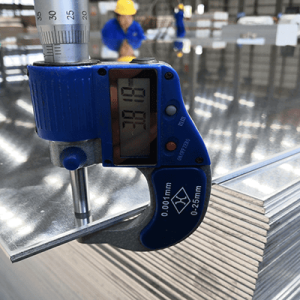
- Thickness tolerance: ±0.01–0.05 mm (ISO 3600 precision levels T1–T5).
- Edge straightness: <1 mm/m (critical for automation in packaging equipment).
4. Manufacturing Process and Performance Optimization
4.1 Raw Material Preparation
Purified ingot production (99.7+%) employs DC casting under inert gas to minimize impurities.
4.2 Rolling Process
Hot Rolling
- Initial reduction to 30 mm thick.
- Performed at 400–500°C to dissolve oxides and improve grain structure.
Cold Rolling
- Achieves final thickness via successive passes at room temperature.
- Reduces gauge by 50% per pass, increasing yield by 0.3 MPa/pass.
4.3 Annealing
Solution annealing at 480°C stabilizes microstructure, balancing strength and formability.
4.4 Surface Treatment
Anodizing
Electrochemical process creates 10–25 µm oxide layer—ideal for:*aluminum electrolytic capacitor terminals, aircraft exterior panels.
Powder Spraying
- 200–2000 micron coatings for mechanical protection.
- Used on Langhe’s washed-meat storage trays (e.g.,
Spray X-9Mfinish).
Physical Polishing
Transmits 92% of visible light in Type 8 polished (mirror finish), used for smartphone backs and medical tools.
4.5 Quality Inspection
- Non-destructive testing (NDT): UT inspection for subsurface cracks.
- Certifications: ASI (Aluminum Stewardship Initiative), ISO 14001.
5. Mechanical properties of 3004 aluminum sheet
3004 aluminum plate is a commonly used aluminum alloy material, widely used in industrial manufacturing, packaging, construction and other fields.
Its mechanical properties vary under different heat treatment conditions, and understanding these properties is crucial for material selection and application.
5.1 Common heat treatment conditions
The heat treatment state of aluminum alloy mainly includes:
- As-cast (F): The casting state without heat treatment or processing.
- Annealed (O): After full annealing, it has the highest ductility.
- Solution treated (S): After solution treatment and natural aging, it has a certain strength.
- Artificially aged (T): After artificial aging treatment, the strength is further improved.
5.2 Mechanical properties of 3004 aluminum sheet
The following are typical mechanical properties of 3004 aluminum sheet under common heat treatment conditions:
| Heat treatment state | Yield strength (MPa) | Tensile strength (MPa) | Elongation (%) |
|---|---|---|---|
| Cast state (F) | 35-55 | 90-130 | 10-15 |
| Annealed state (O) | 40-60 | 100-150 | 20-25 |
| Solution treatment state(S) | 50-70 | 130-180 | 15-20 |
| Artificial aging state(T) | 70-90 | 180-230 | 10-15 |
Note: The above data are typical values, and specific performance may vary due to production process and material batches.
5.3 Performance characteristics analysis
- As-cast (F): As-cast aluminum sheet has low strength due to lack of heat treatment, and is mainly used in applications where strength requirements are not high.
- Annealed (O): After annealing, the ductility and plasticity of the material are improved, and it is suitable for areas that require deep processing.
- Solution treated (S): The aluminum sheet in this state has high strength and is suitable for applications with certain strength requirements.
- Artificially aged (T): After artificially aged, the material reaches its highest strength, but the elongation is reduced, and it is suitable for applications with high strength requirements.
6. Comparison with Other Series of Aluminum Sheets
3004 aluminum is part of the 3xxx series, which is primarily alloyed with manganese.
Engineers favor this material across multiple applications thanks to its optimal balance of strength, formability, and corrosion resistance.
However, to fully understand its performance characteristics, it is useful to compare it with other common aluminum alloys, such as the 1000 and 5000 series.
Below is a detailed comparison of 3004 aluminum sheet with 1000 series aluminum sheets and 5000 series aluminum sheets.
6.1 Comparison of 3004 Aluminum Sheet with 1000 Series Aluminum Sheet
The 1000 series aluminum alloys are primarily composed of 99% pure aluminum, which provides excellent corrosion resistance, high thermal and electrical conductivity, and excellent workability.
However, they have relatively low strength compared to alloys like 3004. Here is a comparison of 3004 and 1000 series aluminum sheets:
| Property | 3004 Aluminum Sheet | 1000 Series Aluminum Sheet |
|---|---|---|
| Composition | Manganese as the main alloying element (1.0-1.5% Mn) | 99% pure aluminum, minimal alloying elements |
| Tensile Strength | 180-290 MPa (depending on temper) | 70-150 MPa |
| Yield Strength | 120-240 MPa (depending on temper) | 30-100 MPa |
| Elongation | 5-15% | 20-30% |
| Corrosion Resistance | Excellent, similar to 1000 series | Excellent |
| Formability | Good, can be used for moderate forming | Excellent, ideal for deep drawing and bending |
| Heat Conductivity | Good | Excellent (due to high purity) |
| Applications | Roofing, siding, and cooking utensils | Electrical conductors, foil, and decorative applications |
Key Differences:
- Strength: 3004 aluminum offers significantly higher strength than 1000 series, making it more suitable for structural and industrial applications that require moderate strength.
- Workability: While the 1000 series excels in formability due to its high purity and ductility, the 3004 series strikes a balance between strength and workability, suitable for more demanding applications.
- Applications: 1000 series aluminum is mostly used in electrical and decorative applications, while 3004 aluminum is used in more demanding structural applications such as roofing, siding, and food containers.
6.2 Comparison of 3004 Aluminum Sheet with 5000 Series Aluminum Sheet
The 5000 series aluminum alloys derive their superior performance from magnesium additions, delivering exceptional corrosion resistance—especially in demanding marine applications.
The strength of 5000 series aluminum is higher than the 1000 series, but typically lower than the 3000 series in terms of overall strength.
A comparison between 3004 and 5000 series aluminum sheets is outlined below:
| Property | 3004 Aluminum Sheet | 5000 Series Aluminum Sheet |
|---|---|---|
| Composition | Manganese as the main alloying element (1.0-1.5% Mn) | Magnesium as the main alloying element (2.2-5.0% Mg) |
| Tensile Strength | 180-290 MPa (depending on temper) | 220-350 MPa |
| Yield Strength | 120-240 MPa (depending on temper) | 140-280 MPa |
| Elongation | 5-15% | 10-20% |
| Corrosion Resistance | Excellent, especially in industrial environments | Excellent, particularly in marine environments |
| Weldability | Good, but not as good as 5000 series | Excellent, especially in marine applications |
| Workability | Moderate, offers good formability | Moderate, more suitable for high-strength applications |
| Applications | Roofing, siding, cooking utensils | Marine structures, pressure vessels, tanks |
Key Differences:
- Strength: 5000 series alloys are typically stronger than 3004 aluminum, making them suitable for more demanding applications, such as pressure vessels and marine structures.
- Corrosion Resistance: While both 3004 and 5000 series exhibit excellent corrosion resistance, the 5000 series, with its magnesium content, offers superior performance in marine environments and saltwater applications.
- Weldability: The 5000 series is better suited for welding, which is an important consideration in applications like shipbuilding and marine structures.
- Applications: The 5000 series excels in high-strength applications where corrosion resistance is critical, especially in marine environments, while 3004 is more commonly used in construction and industrial sectors.
Summary of Comparisons:
- Strength and Durability: 3004 aluminum provides a good balance of strength and formability for general industrial applications, while the 5000 series is stronger and more suitable for high-strength applications, particularly in the marine industry. The 1000 series is the weakest but offers excellent formability.
- Corrosion Resistance: Both 3004 and 5000 series offer excellent corrosion resistance, but the 5000 series is superior in marine environments due to its magnesium content.
- Workability: 1000 series aluminum excels in workability, while 3004 offers a moderate level of formability, and the 5000 series offers moderate workability but with better performance in welded applications.
7. Application of 3004 Aluminum Sheet
The 3004 aluminum sheet, known for its excellent corrosion resistance, moderate strength, and ease of processing, is widely used in several industries.
Its versatility makes it suitable for applications ranging from industrial manufacturing to consumer goods.
Below is an overview of the main areas where 3004 aluminum sheets are commonly utilized:
7.1 Industrial Manufacturing
In industrial manufacturing, the 3004 aluminum sheet is often used for applications that require a balance between strength, formability, and durability.
Some common uses include:
- Heat exchangers: Due to its good thermal conductivity and corrosion resistance, 3004 aluminum sheets are ideal for making heat exchangers used in industrial machinery.
- Automated systems: The aluminum’s high strength-to-weight ratio makes it useful in creating structural components for robots and other automated systems.
- Packaging machinery: Components that require durability and resistance to corrosion in processing environments, such as conveyor belts, housings, and enclosures.
3004 aluminum’s ability to resist wear and tear in harsh environments makes it perfect for manufacturing durable and cost-effective parts.
7.2 Packaging Industry
The packaging industry often relies on 3004 aluminum sheets for producing lightweight, durable, and corrosion-resistant products.
Key applications include:
- Food packaging: The food and beverage industry relies on 3004 aluminum for foil and cans because it creates an impermeable barrier against moisture, oxygen, and light.
- Drink cans: Soft drink and beer cans are frequently made using 3004 aluminum because of its malleability and resistance to corrosion, ensuring the beverage inside stays fresh.
- Trays and containers: Food packaging manufacturers choose 3004 aluminum sheets for meal containers and trays because they meet FDA food-contact standards while resisting corrosion.
The excellent surface finish, corrosion resistance, and ease of processing make 3004 aluminum a popular choice in the packaging sector.
7.3 Construction Industry
Construction professionals select 3004 aluminum sheets for diverse applications, leveraging their optimal strength-to-weight ratio and superior environmental resilience.
Applications include:
- Roofing and siding: Builders favor 3004 aluminum for metal roofing and siding because it delivers exceptional weather resistance and stands up to extreme environmental challenges.
- Curtain walls: In building facades, 3004 aluminum is used in the production of curtain walls because it offers durability and aesthetic appeal with minimal maintenance.
- Architectural panels: The aluminum’s ease of formability and aesthetic properties make it ideal for producing custom-designed architectural panels used in both residential and commercial buildings.
Due to its resistance to rust and corrosion, 3004 aluminum is highly valued in the construction of durable and low-maintenance buildings.
7.4 Transportation
The transportation industry takes advantage of 3004 aluminum for its lightweight, high strength, and resistance to corrosion.
Specific applications include:
- Vehicle parts: 3004 aluminum is used in producing structural components, panels, and cladding for cars, trucks, and buses. Its lightweight nature reduces vehicle weight, improving fuel efficiency without compromising strength.
- Railway components: Rail manufacturers rely on 3004 aluminum sheets for train body panels and structural frames, capitalizing on the alloy’s exceptional weather resistance and long-term durability.
- Aircraft components: While not as common as other high-strength alloys, 3004 aluminum can be used for non-structural components in the aerospace industry, including certain internal parts and fittings.

The low weight-to-strength ratio and corrosion resistance of 3004 aluminum contribute significantly to the efficiency and longevity of vehicles and transport equipment.
7.5 Electrical Appliances and Lighting
The electrical appliances and lighting industries benefit from 3004 aluminum’s properties in several ways.
Common uses include:
- Lighting fixtures: 3004 aluminum is used in the production of lighting fixtures, where the material’s aesthetic qualities and durability are highly valued.
- Heat sinks: Thanks to its excellent thermal conductivity, 3004 aluminum effectively dissipates heat in electrical and electronic devices, keeping sensitive components at optimal temperatures.
- Electrical enclosures: Electrical appliance manufacturers frequently choose 3004 aluminum for enclosures, as it delivers the ideal balance of lightweight durability and environmental resistance.
The lightweight and corrosion-resistant properties of 3004 aluminum make it an ideal choice for electrical appliances and lighting components, especially in high-performance environments.
7.6 Other Uses
In addition to the applications mentioned above, 3004 aluminum sheets have a variety of other uses across different industries, such as:
- Solar panels: 3004 aluminum sheets are used for solar panel frames due to their corrosion resistance and ability to withstand outdoor environmental conditions.
- Marine applications: While marine applications typically favor 5000 series alloys, 3004 aluminum serves well for non-structural components and equipment in mild seawater conditions.
- Home goods: Manufacturers craft common household items like cooking utensils, decorative panels, and heat-resistant components from versatile 3004 aluminum.
The versatility of 3004 aluminum extends beyond traditional industries, showcasing its broad applicability in everyday consumer goods, renewable energy systems, and more.
8. Conclusion
The 3004 aluminum sheet stands as a critical intersection between utility and affordability, fulfilling roles from food packaging to aerospace innovation.
Langhe’s specifications exemplify modern quality standards through rigorous testing and sustainable practices.
As industries prioritize lighter materials without compromising safety—such as in EV battery casings—the alloy’s role will only expand.
Engineers selecting materials should evaluate tempering states and surface treatments to optimize their specific scenarios.
Related products
-

 Aluminum Sheet Plate, Products
6005 Aluminum Sheet
Name
6005 Aluminum SheetThickness
0.3-6.0 mmWidth
1000 mm – 2600 mm,CustomizeSurface
Bright, polished, hair line, brush, sand blast, checkered, embossed, etching, etc.Technical
Wrought alloy、Cold rolling (CC)、Heat treated (T4/T6) -

 Aluminum Sheet Plate
High‑Strength 2024 Aluminum Sheet Plate – Superior Lightweight Performance
¥6,800.00Elevate your projects with 2024 Aluminum Sheet Plate, offering an exceptional strength‑to‑weight ratio, outstanding corrosion resistance, and reliable fatigue strength—ideal for aerospace, automotive, and marine applications.
-
 Aluminum Sheet Plate
6063 Aluminum Sheet: Achieve Flawless Finishes
¥5,800.00Known for its exceptional surface quality and superior anodizing response, 6063 Aluminum Sheet is the ideal material for architectural trim, decorative components, and applications where aesthetics are paramount.
-

 Aluminum Sheet Plate
Amazing 2024 Aluminum Sheet – The Ultimate Strength Breakthrough
¥6,500.00Explore premium 2024 aluminum sheet, offering exceptional fatigue resistance and elevated tensile strength for aerospace, defense, and high‑performance engineering. Available in T3, T4, and T6 tempers.
-
 Aluminum Sheet Plate
5005 Aluminum Sheet
¥3,680.00Unlock the potential of 5005 aluminum sheet, ideal for superior anodized finishes in architectural, decorative, and electrical uses. Learn its benefits and why it stands out.
-
 Aluminum Sheet Plate
3003 Aluminum Plate
¥3,350.003003 aluminum plate: corrosion-resistant, formable, ideal for tanks, roofing & transport. Available in H14/H24/O tempers, thickness 0.2-150mm. Choose mill, embossed or painted finishes.
-

 Aluminum Sheet Plate
6061 Aluminum Sheet
¥5,450.006061 aluminum sheet provided by Langhe-Alu is a popular industrial material. With its excellent comprehensive performance, it is widely used in aerospace, machinery manufacturing, shipbuilding, automotive industry and architectural decoration.
-

 Aluminum Sheet Plate
1060 Aluminum Sheet
¥3,468.001060 aluminum plate is a common lightweight material belonging to the 1000 series aluminum alloy. It is popular in the market due to its low price, strong corrosion resistance and…
-
 Aluminum Sheet Plate
1050 Aluminum Sheet
¥3,428.001050 aluminum sheet is a commercially pure aluminum alloy (99.5% aluminum content) that belongs to the 1000 series of aluminum alloys.
-
 Aluminum Sheet Plate
2219 T37 Aluminum Sheet
¥10,714.002219 T37 aluminum sheet is a high-strength alloy sheet in the 2000 series aluminum alloy, which is widely used in aerospace, marine engineering, high temperature environment and other fields.